

Kaitiaki Waitī
A documentary series exploring the relationships between people and the freshwater fishes of Aotearoa New Zealand

The Story Behind the Series
Our four-part documentary series is produced as part of Fish Futures, a comprehensive research programme examining relationships between people and freshwater species in Aotearoa. Supported by MBIE's Endeavour Fund, Fish Futures brings together iwi, scientists, and communities to explore how we can achieve just governance of freshwater fish under changing environmental conditions.
The series takes its name from Waitī, the star of the Matariki cluster that watches over freshwater and the life within it — a fitting guide for a journey into the often hidden waterways of Aotearoa and the profound relationships between people and the species who live there. As the videography component of the programme, Kaitiaki Waitī documents the inspiring ways people relate to freshwater species, creating compelling narratives that show how mātauranga Māori and contemporary freshwater science come together to shape how we care for our waterways.
Through this work, we aim to uplift mātauranga Māori, support sustainable practices, celebrate the achievements of communities, and create educational resources that encourage the sharing of knowledge between generations.
“The wellbeing of our people and our waterways are inseparable.”


Featured Species & Stories
-

Tuna - a tātou taonga
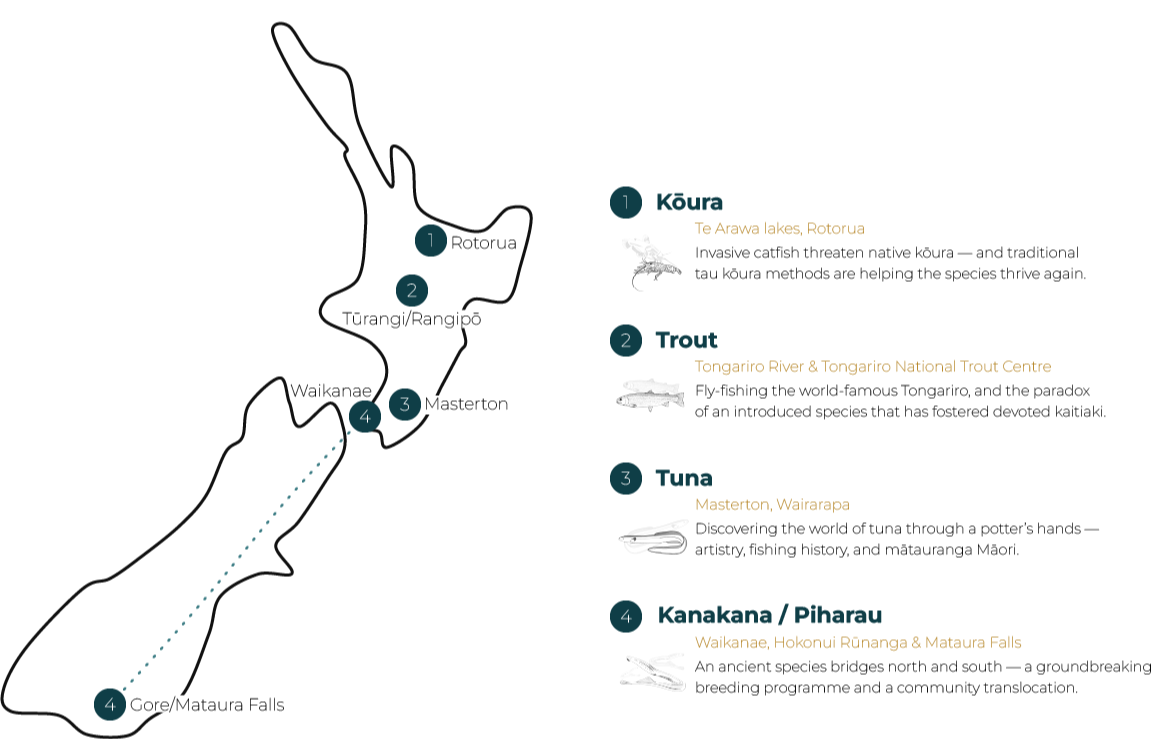
Jamie travels into the Wairarapa to meet potter Sam Ludden (Ngāti Kahungunu) and kaumātua Matt, "the tuna man". Blending artistry, commercial fishing history, and mātauranga Māori, the episode traces the decline of the species and the hope for its recovery.
-

Catfish v kōura – the battle for the lake
Following in the footsteps of the ancestors, cultural expert Tihini Grant leads a reflective journey through the Te Arawa lakes. The episode examines the devastating impact of invasive catfish on native kōura and shows how traditional methods like tau kōura can help the species thrive again.
-

Kanakana (Piharau) - the little living fossil
Jamie steps away from the coast to learn about the ancient, 350-million-year-old pouched lamprey. The journey bridges the Kāpiti Coast's Whakarongotai whānau and the Hokonui Rūnanga in the South Island, featuring a groundbreaking breeding programme and a community translocation effort at the Mataura Falls.
-

Trout - smoking good kai
Jamie learns to fly-fish on the world-famous Tongariro River with expert wāhine anglers Marion and Cherry, before sharing a hot-smoked catch with a young local fisherman, Tohu. The episode explores the paradox of an introduced species that has nonetheless fostered a dedicated community of kaitiaki.
Filming Locations

Our series presenter
Jamie McCaskill
Born and raised by the ocean in Thames and now living on the coastal shores of Lyall Bay, Jamie McCaskill (Ngāti Tamaterā) has spent his life close to the water — first as a fisherman, then as one of Aotearoa's most versatile storytellers.
A Bruce Mason Award-winning playwright, founding member of The Māori Sidesteps, and a driving force behind acclaimed Māori theatre company Tikapa Productions, Jamie has spent more than two decades exploring identity and belonging across theatre, television, and music.
In Kaitiaki Waitī, the saltwater man turns inland. Journeying from the North Island to the deep south, Jamie meets the kaitiaki caring for Aotearoa's freshwater taonga — discovering the world of tuna through a potter's hands in the Wairarapa, tracing the ancient journey of the kanakana, witnessing the fight to protect kōura from an invasive predator in the Te Arawa lakes, and learning to fly-fish on the world-famous Tongariro. A curious outsider to the freshwater world, Jamie brings an openness that makes him a natural guide.

Target Audience
Primary
Māori communities, particularly those connected to or interested in freshwater species and engaging in mahinga kai practices
Secondary
New Zealanders, educators, and students
Tertiary
International audiences interested in Indigenous knowledge
Production Timeline
Note: Online release happening SOON!
-
March - December 2025
Gathering information, developing concepts, accessing archives, hiring presenter, and planning logistics.
-
August 2025 - June 2026
Aligned with seasonal patterns of species for optimal filming conditions.
-
October 2025 - July 2026
Editing, sound design, visual effects, and digital repackaging for various platforms.
-
2027
Releasing episodes and executing promotional strategy to maximize engagement.
-
October 2026 - September 2027
If more funding is secured: Repurposing filmed content into alternative formats to test engagement across diverse audience segments and platforms.
